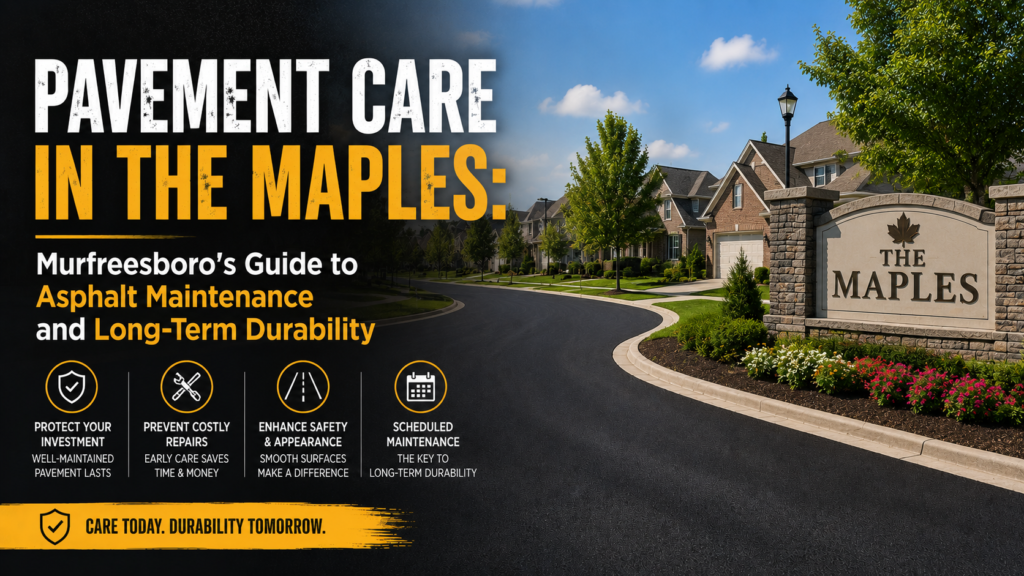
The Maples is one of Murfreesboro’s established residential neighborhoods a community recognized for its quality of life, attractive homes, and the kind of settled, well-tended character that comes from a neighborhood where residents invest in their properties over time. With spacious homes, park-like settings, and recreational amenities that encourage an active and connected lifestyle, The Maples offers a residential experience that residents are understandably motivated to protect and preserve.
Among the many elements that contribute to a property’s appearance and function, the condition of the driveway and any other paved surfaces on or adjacent to the property is one of the most visible. A well-maintained driveway in The Maples speaks to a homeowner’s care for their investment. A cracked, faded, or potholed surface can undermine the overall impression of even a beautifully maintained home. Understanding what quality asphalt Paving Contractor The Maples and maintenance involves and what the specific demands of Middle Tennessee’s climate mean for pavement care empowers property owners to make informed decisions that protect both their investment and their home’s presentation.
Understanding Asphalt as a Living Surface
One of the most useful ways to think about asphalt pavement is as a living surface that responds to its environment over time. Unlike a static material such as concrete, which either holds or breaks, asphalt is a viscoelastic material meaning it has both elastic properties (it deforms under load and largely recovers) and viscous properties (it flows slowly under sustained load, particularly at elevated temperatures). This behavior makes asphalt uniquely suited to the demands of residential paving but also means it requires ongoing care to maintain its performance.
Fresh asphalt is flexible and resilient. The bituminous binders that hold the aggregate particles together are in their optimal state full of oils that maintain the material’s flexibility and binding strength. Over the first several years of a pavement’s life, these binders begin to oxidize under exposure to UV radiation and oxygen. As oxidation progresses, the binders lose their oil content and become increasingly rigid and brittle.
This transition from flexible to brittle is the underlying process behind almost all the surface deterioration that property owners in The Maples will observe in their driveways over time. Surface cracking, raveling (the loss of surface aggregate as binder strength declines), and the eventual structural failure that follows water infiltration through surface cracks are all manifestations of this process.
Understanding this helps explain why sealcoating which directly addresses the oxidation process by protecting binders from UV and oxygen exposure is so important, and why it works best when applied before oxidation has progressed to the point of visible cracking.
The Paving Contractor’s Role: More Than Laying Asphalt
A qualified paving contractor in the Murfreesboro area provides a range of services that extend well beyond the installation of new asphalt. For property owners in The Maples whose driveways or other paved surfaces need attention, understanding the full scope of what professional paving contractors offer is useful context.
Assessment and Diagnosis: A professional paving contractor’s first role is to accurately assess the condition of existing pavement and diagnose the causes of any deterioration. This requires more than simply observing visible surface conditions it involves understanding the pavement’s history, the site’s drainage characteristics, and the condition of the base beneath the surface. A proper assessment determines whether surface maintenance is appropriate or whether more fundamental repair is required.
New Pavement Installation: When a driveway has deteriorated beyond the point of cost-effective maintenance, or when a new surface is needed, full installation involves site preparation, base construction, and asphalt placement and compaction. This is the most comprehensive service but also the one with the longest expected service life when done correctly.
Resurfacing and Overlay: For driveways with sound bases but worn surfaces, resurfacing provides a cost-effective renewal. A new asphalt layer is applied over the existing surface after appropriate preparation, extending the driveway’s service life without the full expense of replacement.
Maintenance Services: Crack sealing, crack filling, pothole patching, sealcoating, and surface cleaning are the regular maintenance services that maximize pavement life. These services are most effective when performed as part of a planned maintenance schedule rather than reactively after significant deterioration has occurred.
Line Striping and Markings: For any paved surfaces requiring markings including community parking areas, HOA-managed spaces, or properties with multiple parking stalls professional striping ensures clear, ADA-compliant, and visually crisp markings.
In The Maples, where the paving context is primarily residential driveways and potentially community-managed parking areas, property owners are most likely to engage with maintenance services sealcoating, crack sealing, and targeted repair on an ongoing basis, with full replacement or resurfacing as less frequent but periodically necessary interventions.
Sealcoating in The Maples: Timing, Frequency, and Process
Sealcoating is the cornerstone of residential asphalt maintenance, and for homeowners in The Maples, understanding when and how it is properly applied makes the difference between a service that provides lasting value and one that fails prematurely.
When to Apply: New asphalt should not be sealcoated immediately after installation. The pavement needs six to twelve months to fully cure during which the volatile oils in the fresh asphalt evaporate and the binders stabilize. Sealing too soon can trap oils in the pavement, interfering with the curing process and the adhesion of the sealcoat itself. After the first application, subsequent sealcoating is typically recommended every two to four years for residential driveways, adjusted based on the specific traffic, sun exposure, and climate conditions experienced at the property.
Seasonal Timing: In Middle Tennessee, the optimal windows for sealcoating are spring (once temperatures are consistently above 50°F and rain is not forecast) and late summer through early fall. Sealcoating requires dry, warm conditions for proper application and curing it should not be applied when rain is expected within 24 hours, when temperatures are below 50°F, or when surfaces are damp.
Surface Preparation: Proper sealcoating begins with thorough surface preparation. The pavement must be swept and blown clean of all dirt, leaves, and debris. Oil stains a common feature of residential driveways where vehicles park regularly must be treated with a special primer that prevents them from bleeding through and compromising the sealcoat’s adhesion. Any cracks or surface voids must be filled and allowed to cure before the sealcoat is applied over them.
Application: Quality sealcoat is typically applied in two coats, each applied to the full surface area. The first coat seals the surface and provides the foundational layer; the second coat covers any missed areas and builds the protective thickness. Equipment ranges from spray systems for large, open areas to squeegee or brush application for edging and areas near buildings or landscaping.
Curing: After application, sealcoated surfaces must be kept free of vehicle and foot traffic for a minimum of 24 hours, and longer in cool or humid conditions. Driving or walking on sealcoat before it has fully cured can cause tracking, marring, and adhesion failure.
The visible result of properly applied and cured sealcoat is a deep, uniform black surface that transforms the appearance of an aging driveway one of the most impactful and cost-effective cosmetic improvements available to homeowners in The Maples.
Pavement Striping for Community Spaces
The Maples, like many established residential communities in Murfreesboro, includes shared amenity spaces community pools, clubhouses, fitness facilities, and associated parking areas that require properly maintained pavement markings to function safely and remain compliant with accessibility requirements.
Parking lot striping serves multiple purposes that are easy to underestimate until they are absent. Clearly painted stall lines allow the maximum number of vehicles to park in an organized, predictable manner. Without defined stalls, drivers park inconsistently, reducing effective capacity and creating confusion. Directional arrows and entrance/exit markings regulate traffic flow, reducing the risk of vehicle conflicts in a shared space. Pedestrian crosswalk markings at the intersections of vehicle traffic lanes and pedestrian pathways provide a visual cue that protects residents and visitors on foot.
ADA-compliant accessible parking stalls represent a legal obligation for commercial and public accommodation properties, and best practice for any well-managed community facility. These stalls require specific dimensions, appropriately marked access aisles, and compliant signage. Faded or missing accessible markings can create both safety and liability concerns for community management.
Pavement markings fade due to UV exposure, weather, and traffic wear. In Middle Tennessee’s climate, striping in frequently used areas typically requires refreshing every one to two years. Fresh markings are most durable and adhesive when applied to clean, dry pavement for this reason, re-striping is most commonly scheduled in conjunction with sealcoating, which both prepares the surface and provides the dark, uniform background that maximizes the visual contrast and visibility of new markings.
The striping process itself involves surface preparation (cleaning the pavement to remove debris and ensure adhesion), layout (marking the positions of stalls, arrows, and symbols using string lines, chalk lines, or spray templates), and application (using specialized line striping machines that deliver precise, even paint application at the correct width and thickness). High-quality traffic paint or thermoplastic marking materials are selected based on the expected traffic and durability requirements.
Asphalt Repair: Matching the Treatment to the Condition
Not all asphalt repair is the same, and not every repair method is appropriate for every type of damage. For property owners in The Maples, understanding the range of repair approaches and what determines which is right for a given situation helps set appropriate expectations for maintenance work.
Crack Filling: For isolated non-structural cracks that are less than one-quarter inch wide and show no signs of base distress, cold-applied crack filler or hot-pour crack sealant provides an effective repair. The goal is to seal the crack against water infiltration and prevent it from growing before conditions deteriorate further.
Infrared Asphalt Repair: Infrared technology allows technicians to heat an existing asphalt surface to make it workable again, add new asphalt material, rework the area, and re-compact it creating a seamless, fully bonded repair that is more durable than a cold patch because it integrates with the surrounding pavement rather than simply filling the void. This approach is particularly effective for potholes, depressions, and damaged areas in otherwise sound pavement.
Saw-Cut Patching: For more significant localized failures, the damaged area is saw-cut to clean, straight edges, the failed material and compromised base are excavated, the base is rebuilt to the appropriate depth and compacted, and new hot mix asphalt is placed and compacted flush with the surrounding pavement. This method produces a repair that is both structurally sound and visually integrated with the surrounding surface.
Mill and Overlay: For driveways or larger surfaces where extensive surface deterioration is present across a wide area but the base remains sound, milling the existing surface to a controlled depth and placing a new overlay provides a comprehensive renewal without the cost of full removal and reconstruction.
Full Depth Reclamation: For surfaces with both deteriorated pavement and compromised base, full depth reclamation pulverizing the existing pavement and processing it into a new base course before placing a new asphalt surface can provide an economical path to a fully reconstructed pavement system.
The selection of the appropriate repair method is not just a technical decision it is also an economic one. Matching the depth and cost of the repair to the actual condition of the pavement ensures that maintenance dollars in The Maples are spent effectively, producing the maximum extension of service life for the investment made.
Building a Long-Term Pavement Maintenance Plan
The most cost-effective approach to pavement management in The Maples whether for an individual driveway or for a community association managing shared pavement assets is a planned maintenance program rather than a reactive repair approach.
Reactive maintenance waiting until pavement has deteriorated to the point where it is visibly failing, then repairing is consistently more expensive over the long term than proactive maintenance that addresses issues early in their development. Studies of pavement management at the municipal level consistently demonstrate that early-stage maintenance like crack sealing and sealcoating extends pavement life at a fraction of the cost of the reconstruction that is eventually required when maintenance is deferred.
A practical maintenance plan for a residential driveway in The Maples might look like this: apply sealcoat six to twelve months after installation; inspect annually, particularly after winter, for cracks, surface changes, or drainage issues; seal any new cracks identified in the fall inspection before winter; reseal every two to four years as the surface begins to fade; address any localized failures with appropriate patching as they develop; and plan for resurfacing or full replacement when the surface has reached the end of its economic life typically after 15 to 20 years with proper maintenance.
For HOA-managed community pavement assets in The Maples, a similar planning approach periodic professional condition assessments, scheduled maintenance activities, and capital planning for eventual major rehabilitation provides the financial predictability that community associations need to manage their budgets responsibly.
A qualified paving contractor with experience in both residential and community paving in the Murfreesboro area can assist in developing a maintenance plan appropriate for the specific pavement assets at any property in The Maples, providing the professional guidance that transforms reactive repair spending into proactive asset management.