In busy hospitals, telecom showrooms, and government one-stop shops, the difference between chaos and calm often comes down to one thing: how well the waiting is managed. Digital queuing has quietly become one of the most impactful IT investments a service organisation can make in 2026. This article looks at queue management through the lens of patient and customer flow, and how it connects to the broader business technology backbone.
From Paper Tickets to Intelligent Flow Management
A decade ago, a numbered paper ticket was the whole system. Today, queuing platforms orchestrate the entire visitor journey and feed managers a live command centre. The shift matters because expectations have changed: people now expect to check in by phone, wait comfortably, and get a nudge when their turn approaches.
Across the Gulf, service-quality mandates have pushed organisations to modernise fast. Deploying a queue management system in saudi arabia lets a hospital in Jeddah route patients to the correct department automatically, reducing crowding at reception and improving infection-control distancing that remains a priority in healthcare settings.
Why Flow Beats Speed
Counterintuitively, the goal is not always faster service. It is predictable, fair, and transparent service. A patient who knows they are seventh in line and will be seen in roughly 20 minutes is far calmer than one staring at an opaque crowd. Managing expectations reduces complaints more than shaving seconds off each transaction.
The Anatomy of a Modern Queuing Deployment
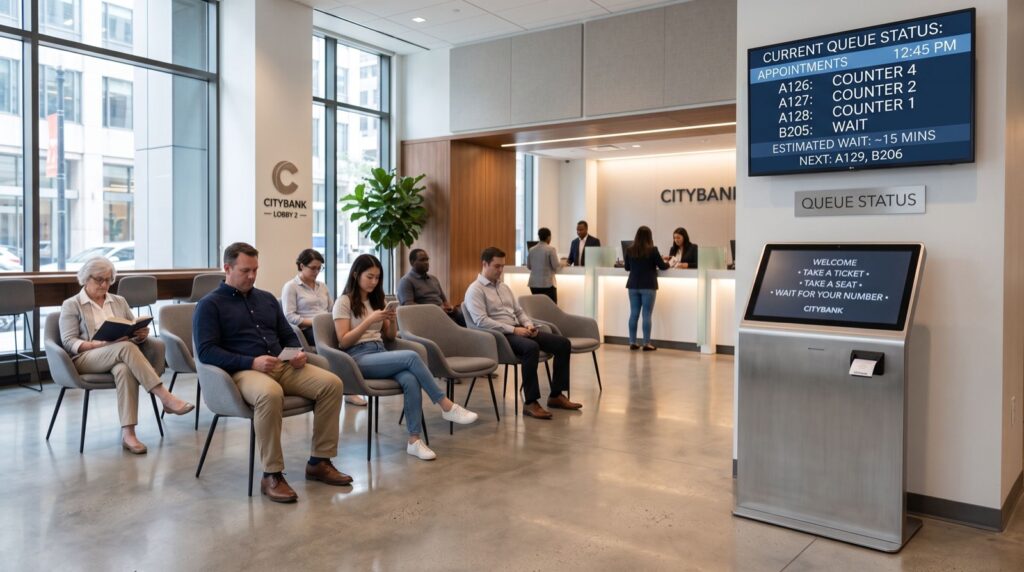
A robust deployment blends software, hardware, and network engineering. Skimp on any one and the whole experience suffers. Here is what a complete rollout usually includes:
- Self-service kiosks or QR-based mobile check-in at the entrance.
- A ticketing engine that classifies visitors by service type.
- Digital signage and audio calling to guide people to counters.
- Agent dashboards for staff to call, recall, and transfer tickets.
- An analytics layer reporting wait times, service times, and no-shows.
Every one of these components depends on stable networking. Kiosks, displays, and calling screens all talk to a central server, so switch capacity and structured cabling determine whether the system feels instant or laggy.
Regional Realities: The Gulf and South Asia Compared
Buying criteria shift with geography. In the Gulf, bilingual Arabic-English interfaces and government data-residency rules dominate. In Pakistan, decision-makers weigh multi-branch centralisation and total cost of ownership more heavily.
A bank or utility evaluating a queue management system in karachi typically prioritises a centralised dashboard that consolidates dozens of branches into one view, plus responsive local maintenance so a failed kiosk never idles a busy counter for long.
Feature Priorities by Sector
| Sector | Top Priority | Key Feature |
|---|---|---|
| Healthcare | Patient flow & privacy | Department routing, quiet calling |
| Banking | Fairness & compliance | Priority tiers, audit logs |
| Telecom retail | Upsell time | Appointment booking, CRM link |
| Government | Transparency | Multi-service kiosks, reporting |
How Queuing Fits the Bigger IT Picture
Queue management should never be planned in isolation. It shares infrastructure with IP telephony, surveillance, and access control. A single Power-over-Ethernet switch can drive kiosks, cameras, and signage together, which cuts both cost and cabling clutter.
Sound cabling discipline underpins all of it. The Telecommunications Industry Association maintains the widely referenced TIA-568 cabling standards, and following them ensures your queuing hardware runs on a network that will still perform when you add more branches. Treat the physical layer as the foundation, not an afterthought.
An Insight Worth Applying
Enable virtual queuing wherever footfall spikes. Letting customers hold their place by phone and arrive just before their turn flattens crowd peaks dramatically. During Ramadan or month-end banking rushes, this single feature can be the difference between a manageable floor and a jammed lobby.
Proving Value After Launch
Once live, measure relentlessly. Track abandonment rate, average wait, and staff utilisation each week. Combine hard metrics with a one-tap satisfaction survey at the end of service so you capture sentiment alongside numbers.
If you are coordinating a larger relocation or fit-out alongside your technology upgrade, partner with reliable local experts who can align logistics with your go-live schedule and keep disruption to a minimum.
Where Queuing Projects Go Wrong
The technology rarely fails on its own; the deployment does. A frequent error is treating queuing as a hardware purchase rather than a service-design project. Buying kiosks without redesigning the customer journey around them produces expensive tickets and little else.
Another pitfall is ignoring the waiting area itself. If people cannot see the calling screen or hear the announcement clearly from where they sit, they crowd the counter regardless of how clever the software is. Sightlines and acoustics deserve as much attention as the application.
Finally, many teams launch without agreeing on which metrics define success. Without a baseline for wait time and abandonment measured before go-live, you cannot prove the improvement afterward. Capture that baseline first, even if it is only a week of manual observation.
A Rollout Sequence That Works
- Map the current visitor journey and record baseline wait times.
- Redesign the flow, then choose hardware that fits the design.
- Pilot at one branch and gather staff feedback for two weeks.
- Refine categories and signage, then roll out region by region.
- Review analytics weekly and coach staff on the real bottlenecks.
What Comes Next for Queuing Technology
In 2026, the frontier is predictive queuing. AI models trained on historical footfall forecast tomorrow’s peaks so managers can roster staff in advance rather than reacting to a jammed lobby. Appointment systems are also merging with virtual queues, letting a patient or customer pre-book and simply confirm arrival by phone.
Expect deeper integration too, with queuing data flowing into CRM, workforce-management, and business-intelligence tools automatically. When you evaluate platforms, favour those with open APIs and a documented upgrade path. The right choice today should still serve you well after your branch network grows.
Frequently Asked Questions
What is the difference between physical and virtual queuing?
Physical queuing uses on-site tickets and signage. Virtual queuing lets customers join remotely by phone or QR code and receive alerts, so they can wait anywhere until their turn is near. Most 2026 systems support both.
Will a queue management system reduce my staffing costs?
Often, yes, indirectly. By revealing true peak hours and per-service handling times, it helps you schedule staff precisely, avoiding both overstaffing quiet periods and understaffing rushes.
Can queuing integrate with a hospital or bank CRM?
Yes. Leading platforms offer APIs that link check-in data to your CRM or patient record, enabling personalised calling and better follow-up reporting.
How secure is the visitor data collected?
On-premise and compliant cloud deployments encrypt data and support role-based access. For regulated sectors, choose a vendor that meets local data-residency and privacy requirements.
Conclusion
A modern queue management system does far more than hand out numbers. It engineers calm, fair, and measurable flow into your busiest moments, and it slots neatly into a unified telecom and IT infrastructure. Whether you run clinics in the Gulf or branches across Pakistan, 2026 is the year to move beyond paper tickets. Reach out to a seasoned IT and telecom partner to design a solution built around your visitors.